Written by: Oka Agastya. Translated by: Hamzah
From July to September, the water of Lake Batur changes color, a pungent sulfur smell fills the air, and thousands of fish die. Many blame volcanic activity. Yet the source is much closer than we think, and the answer lies at the bottom of the lake, which we ourselves have filled with sediment.
In the early hours of Monday, 20 July 2026, around three in the morning, something strange occurred on the surface of Lake Batur. The usually calm blue waters in the areas of Kedisan Village, Dukuh Hamlet, and Abang Songan Village began to change. A pungent sulfur smell was carried by the cold night wind, and when dawn arrived, the lake surface looked different from usual. Fish farmers with floating net cages (Keramba Jaring Apung, or KJA) recognize these signs all too well, and they know what will follow within the next two to three days: mass fish deaths (Tribun Bali, 2026).
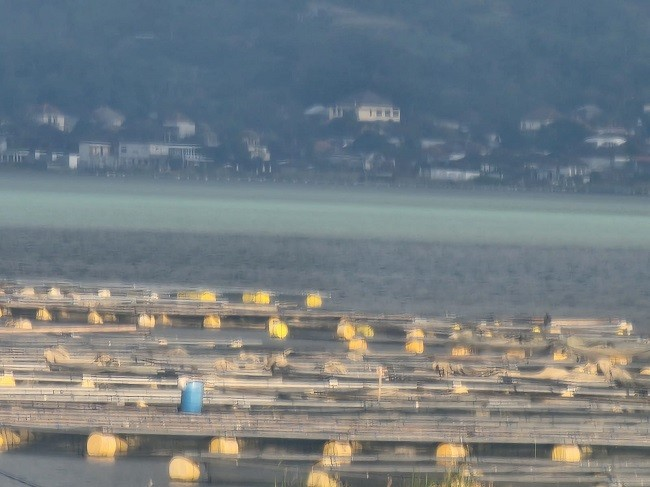
This phenomenon is not new. A year earlier, a sulfur burst was detected from 8 July 2025, continuing to spread until it changed the lake water’s color from blue to white, causing massive fish deaths in the Trunyan, Cemara Landung, Tanggun Titi, and Abang Songan areas (Sarma, in Bali Tribune, 2025). The Head of Fisheries at the Bangli Agriculture Office, I Wayan Agus Wirawan, called it a natural phenomenon that occurs almost every year, particularly from July to September, triggered by very cold weather and strong winds (Tribun Bali, 2026).
But each time this phenomenon goes viral on social media, the narrative that spreads fastest is the one easiest to believe: Mount Batur is active, magma is boiling beneath the lake, and sulfur from the earth’s depths is overflowing to the surface. That narrative sounds plausible, dramatic, and easy to digest. There is just one problem: it is not accurate.
What Actually Happens Beneath the Surface
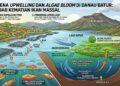
To understand this phenomenon correctly, we need to become acquainted with a process that lake scientists call upwelling, or the overturning of water masses. Deep lakes like Batur, which reaches a depth of almost 91 meters (Stehn, 1928; Kemmerling, 1917) but has now shallowed to 65–84 meters, tend to form layers of water with different temperatures and densities. The warmer, oxygen-rich upper layer is separated from the colder, heavier, oxygen-poor lower layer. In the science of limnology, this condition is called thermal stratification.
During the dry season from July to September, strong winds blowing from the south across the lake surface disturb this balance. The wind pushes the surface water to one side, pulling cold water from the depths up to replace it. When this water mass from the bottom of the lake rises to the surface, it brings with it everything that has been stored there: organic sediment accumulated over many years, hydrogen sulfide (H2S) gas formed from the decomposition of organic matter in oxygen-free conditions, and high concentrations of nutrients in the form of nitrogen and phosphorus. This is what the community experiences as a “sulfur burst” because the pungent smell of H2S is indeed identical to the aroma of rotten eggs, exactly like the sulfur often associated with volcanic activity.
“The source of the sulfur smell is not the belly of the volcano, but the belly of the lake itself, which for years has received organic deposits without the chance to clean itself.”
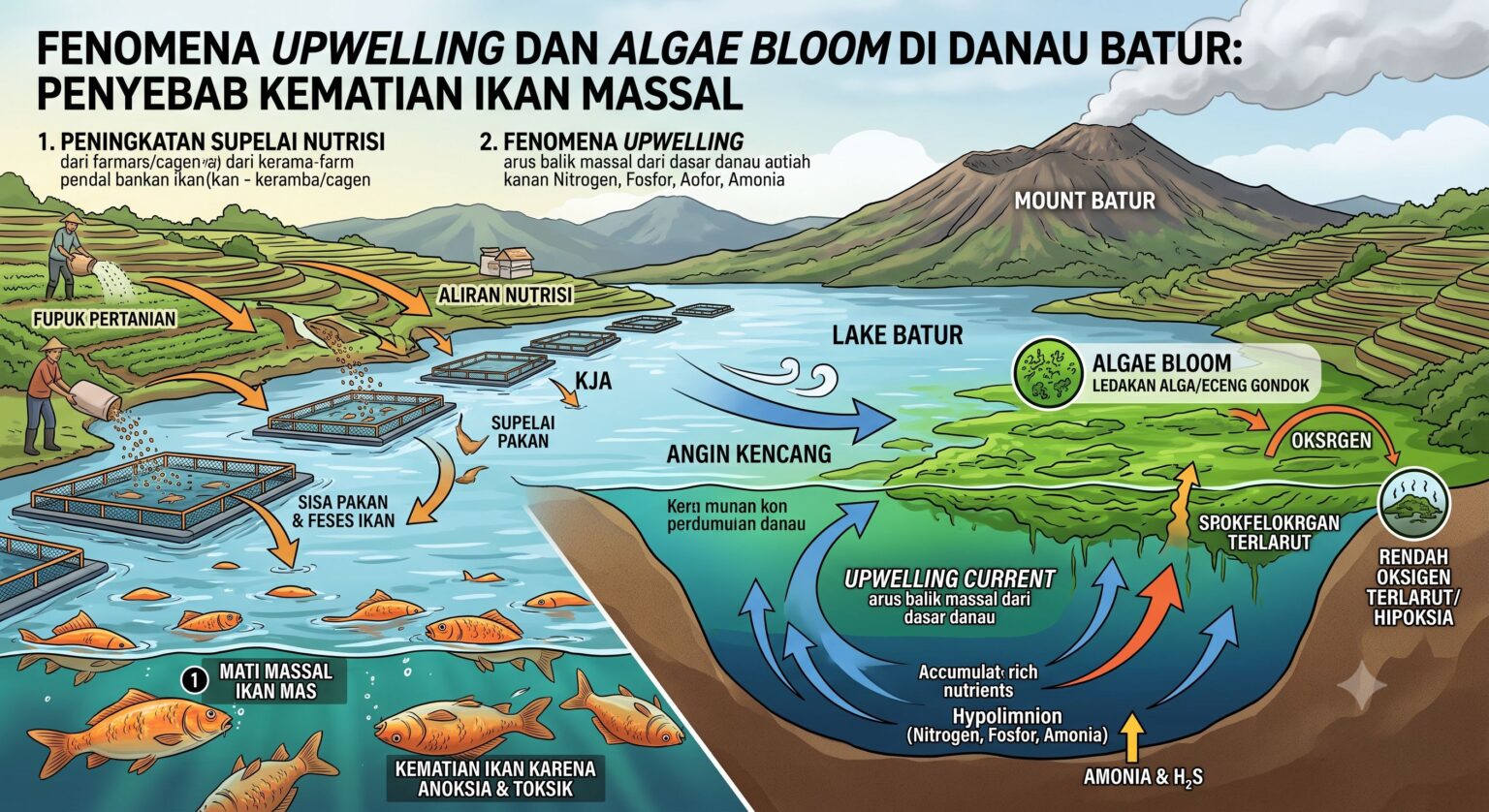
The H2S gas released into the air and dissolved in the water is what kills the fish both in the floating net cages and in the open waters. When the concentration of this gas spikes, the level of dissolved oxygen in the water plummets drastically. Fish exposed to high H2S suffer direct poisoning, while those that survive the toxin die from oxygen starvation. Not because Batur is stirring volcanically, but because the water’s chemical composition changes in a very short time.
When the Lake Bears Too Heavy a Burden
The next question that must be answered is: why is the sediment at the bottom of Lake Batur so rich in organic matter and sulfur compounds that it can produce such large amounts of H2S? The answer does not come from beneath the earth’s crust, but from activities on its surface.
Lake Batur has been designated by the Bangli Regency Government as a minapolitan development area, with tilapia as the main commodity cultivated in floating net cages (KJA). Over the years, the number of KJA in the lake has continued to grow. Each KJA contributes uneaten feed residues, fish waste, and other metabolic products directly into the water body. Research conducted in Lake Batur shows that the contribution of KJA to nitrogen pollution reaches 45.19 percent (Sani et al., 2024), a very significant figure in driving a condition known as eutrophication—excessive nutrient enrichment that spurs the uncontrolled growth of algae and phytoplankton.
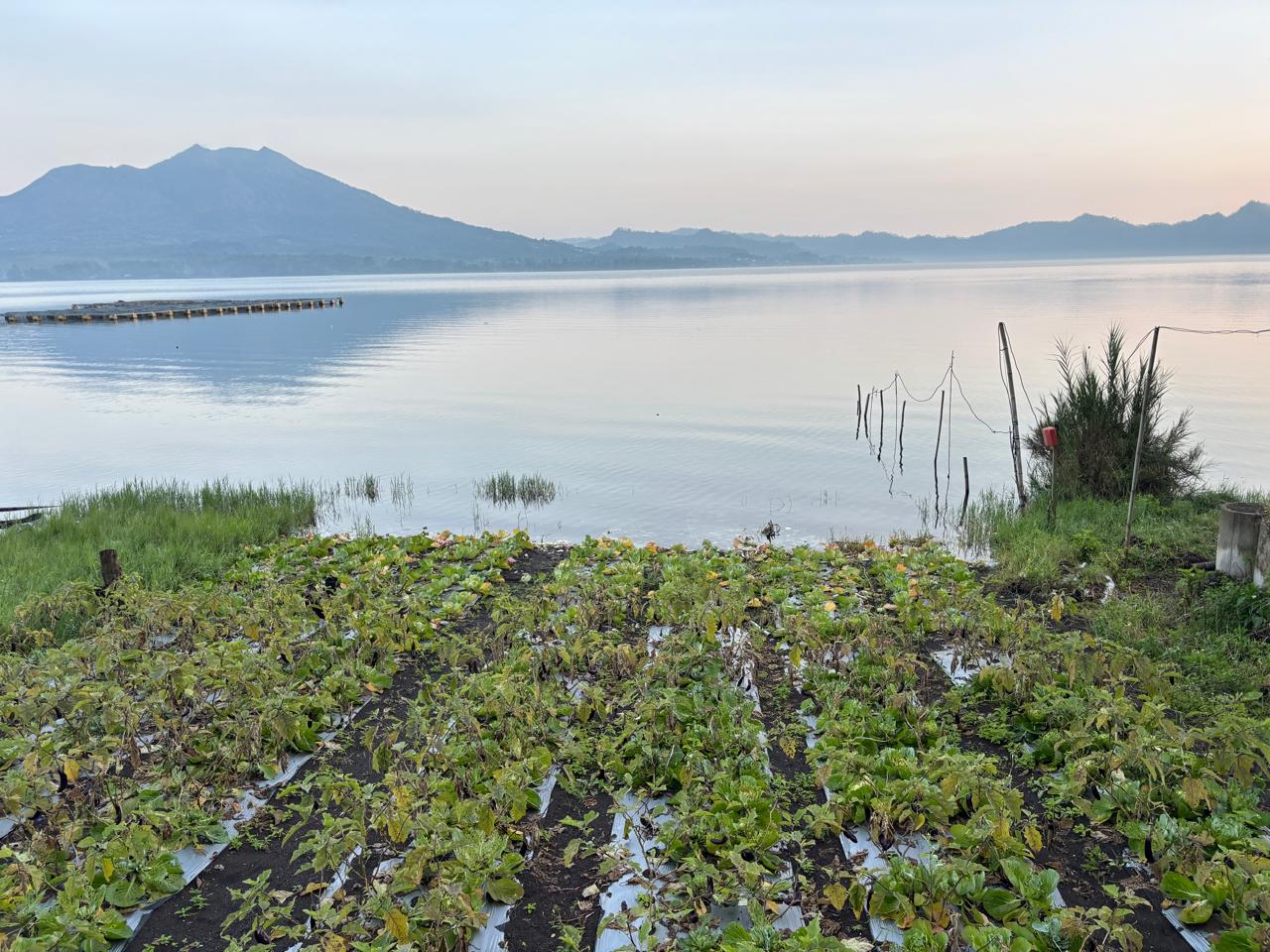
Besides the KJA, agriculture in the lake’s catchment area is also an important contributor. Fertilizers containing nitrogen and phosphorus used in the fields around the caldera are carried by surface runoff during rain and flow into the lake. Limnological research by BRIN and LIPI, which regularly monitors Indonesia’s national priority lakes, including Lake Batur, has long identified this pattern. In the Grand Design of Indonesian Limnology Research (LIPI Limnology Research Center, 2020), Lake Batur is listed among the lakes requiring special attention regarding nutrient loads and the trophic status of its waters. Analysis of the trophic level index shows that Lake Batur is already classified as eutrophic (Suryono et al., 2008; Bangli Fisheries Office in ResearchGate, 2023).
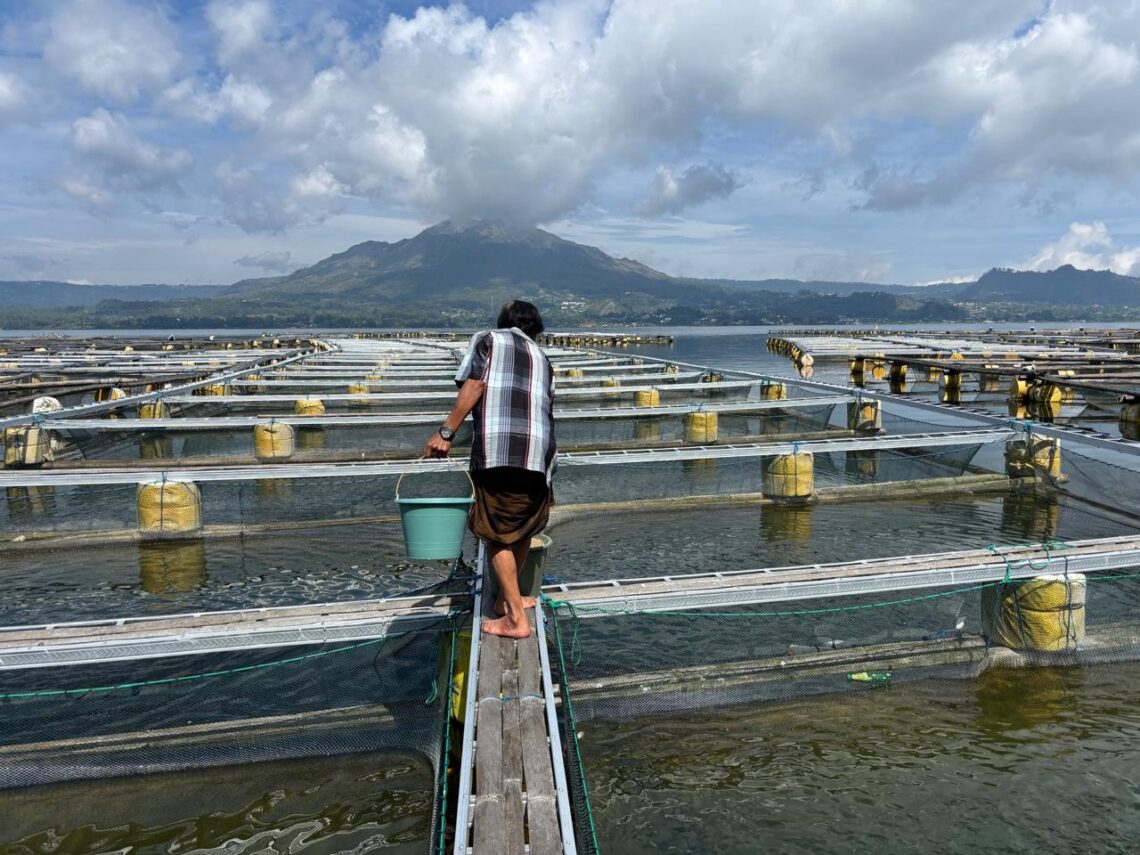
When this nutrient-rich water sinks to the bottom and is decomposed by bacteria in anoxic (oxygen-free) conditions, the process produces H2S and releases phosphorus stored in the sediment back into the water. This is called internal loading—a cycle where the lake seemingly feeds itself with nutrients that should have already dissolved, but instead are continuously released from the deposits on its bottom (Nikolai and Dzialowski, 2014).
Algal Blooms: Invisible but Deadly
One dimension of this phenomenon that often escapes news coverage is the role of algae or phytoplankton. When nutrients from the KJA, agriculture, and bottom sediment are released simultaneously during upwelling, it acts like a sudden dose of fertilizer spread throughout the water column. Phytoplankton that have long been waiting for these nutrients multiply rapidly in extraordinary numbers, an event known as an algal bloom.
During the daytime, these algae photosynthesize and produce oxygen. But at night, and especially when the algae begin to die in large quantities, the decomposition process instead sucks oxygen from the water. The result is hypoxic conditions—very low oxygen levels—which add to the stress on fish already having to face H?S toxins. The change in the lake water’s color to greenish, whitish, or brownish, often reported by the community, is the visual manifestation of these diverse exploding algae populations.
The community calls it a sulfur burst. Scientists call it a combination of upwelling and algal bloom triggered by eutrophication. Both describe the same event from two very different perspectives, and the second is far more important to understand because it points to the root of the problem that we can address.
Early Warning Signs That Need to Be Understood
The change in water color from blue to greenish, whitish, or brownish is the earliest signal that can be observed visually.
A pungent smell like rotten eggs in the morning and evening indicates that H2S levels have already increased at the water surface.
Wild fish starting to move to the lake’s edges is an instinctive response to the drop in oxygen levels in the central lake zone.
The most critical period is July to September, coinciding with the peak of dry winds from the south and the lowest air temperatures in Kintamani.
Mitigation That Can Be Done Now
A correct understanding of the cause of this phenomenon opens the way for more targeted mitigation. The most urgent and most feasible action is periodic monitoring and early harvesting.
When a change in water color begins to be detected, either by officers or by the farmers themselves, a window of time to save the farmed fish is still open. Experience from previous years shows that the worst impact usually only appears two to three days after the first burst occurs (Agus Wirawan, in Tribun Bali, 2026). Those two to three days are enough time to carry out emergency harvesting if the fish are large enough, or to move the cages to safer zones of the lake if conditions permit.
In addition, avoiding the stocking of new fingerlings in the months of July to September is the easiest preventive measure that can be taken at no additional cost. Newly stocked fingerlings are far more vulnerable to changes in water quality than larger fish with stronger physiological capacity. By not stocking fingerlings during these critical months, losses can be significantly minimized.
For long-term monitoring, a regular observation system is needed, involving collaboration between the local government, BRIN, academics, and the farming community itself. Routine measurements of water quality parameters such as dissolved oxygen levels, temperature at various depths, H?S content, and chlorophyll will allow more accurate predictions of when upwelling will occur, so that early warnings can be delivered sooner. Several lakes around the world have already implemented automatic sensor-based monitoring systems that transmit data in real time, and there is no technological reason why Lake Batur could not have a similar system.
But above all, the most fundamental mitigation is reducing the nutrient load entering the lake. As long as the KJA continues to increase without a scientifically calculated carrying capacity, and as long as agriculture around the lake does not implement practices that reduce nutrient flow into the water body, the next upwelling will always bring more H2S and more dead fish. A lake can tolerate pressure up to a certain limit, but once internal loading becomes too deeply entrenched, restoring it takes far longer than just getting through one dry season.
Lake Batur is an ecological heritage that is also a source of livelihood for thousands of families in Kintamani. It is not angry because the volcano beneath it is stirring. It is signaling that the burden we have placed upon it has exceeded its capacity to recover on its own. And every color change in the water that we see in July is the lake’s way of speaking to us—if only we are willing to listen in the right language.
Original article in Indonesian:
References
Agus Wirawan, I W. (2026). Statement by the Head of Fisheries, Bangli Agriculture Office, regarding the July 2026 Lake Batur sulfur burst. In Tribun Bali, 22 July 2026.
Kemmerling, C.E.A. (1917). Depth measurements of Lake Batur. Cited in Stehn, Ch. E. (1928). Batur te Bali en zijne Uitbarsting in 1926. Vulkanologische Mededeelingen No. 9, Bandung.
Nikolai, S.I. & Dzialowski, A.R. (2014). Effect of internal phosphorus loading on nutrient limitation in a eutrophic reservoir. Limnologica, 49, 33–41.
LIPI / BRIN Limnology Research Center (2020). Grand Design of Limnology Research in Indonesia. Puslit Limnologi LIPI, Bogor.
Sani, et al. (2024). Identification of Water Quality and Nutrient Pollution in Lake Batur from Total Phosphate and Total Nitrogen Parameters. Jurnal Teknologi Lingkungan, 25(2).
Sarma, I W. (2025). Statement by the Head of Agriculture, Food Security and Fisheries Office of Bangli regarding the July 2025 sulfur burst. In Bali Tribune, 14 July 2025.
Smith, V.H., Tilman, G.D., & Nekola, J.C. (1999). Eutrophication: impact of excess nutrient input on freshwater, marine, and terrestrial ecosystems. Environmental Pollution, 100, 179–196.
Suryono, T., Nomosatryo, S., & Mulyana, E. (2008). Trophic status of Lake Diatas-Dibawah and Lake Batur based on Carlson’s Trophic State Index. Proceedings of the IV National Limnology Seminar, IPB, Bogor.
Udayana University / Bangli Fisheries Office (2023). Pilot Project of Environmentally Friendly Floating Net Cages (KJA) in Lake Batur Waters. ResearchGate.
Tribun Bali (2026). Sulfur Burst Reappears in Lake Batur Kintamani Bali, Fish Farmers Gripped by Anxiety. 22 July 2026. tribunnews.com/bali
Detik Bali (2025). Viral Thousands of Fish Die Massively Due to Sulfur in Lake Batur, Here’s the Explanation. 14 July 2025. detik.com/bali