
Written by: I Wayan Budi Adinanta. Translated by: Hamzah
Denpasar is no longer the same as it was two or three decades ago. As the capital of Bali Province and the center of government, commerce, education, and services, the city continues to be a destination for people from various regions seeking work, pursuing education, or building a new life.
This growth in activity brings unavoidable consequences. The need for space continues to increase, while the city’s area does not expand. Amidst these conditions, land prices are rising, and owning a landed house is becoming increasingly unaffordable for many, especially the younger generation.
This phenomenon has reignited discussions about vertical housing, or rumah susun (rusun), as an alternative for providing shelter in urban areas. However, the question that arises is not simply whether rusun need to be built or not. In Bali, the issue of housing is also closely tied to the culture of dwelling, spatial planning, and the identity of a community that has long lived in settlement patterns based on the family compound, or natah.
Denpasar is Getting More Crowded
Data from the Central Statistics Agency (BPS) of Denpasar for 2025 shows the city’s population has reached over 760,000 people. With a relatively limited area, the city’s population density reaches around 5,369 people per square kilometer.
This density is not evenly distributed. West Denpasar is the area with the highest density, reaching over 8,000 people per square kilometer. North Denpasar follows, then East and South Denpasar.
These figures illustrate that residents’ activities are increasingly concentrated in urban areas. Besides permanent residents, Denpasar is also a destination for people from various parts of Bali and beyond who come to work, start businesses, or access education and health services.
In recent years, population dynamics have grown more complex. The incoming flow originates from other regencies in Bali and various regions in Eastern Indonesia. This condition also increases the need for housing close to centers of economic activity.
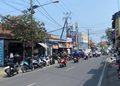
On the ground, this need for housing is reflected in the proliferation of boarding houses, rental properties, and new housing estates in various corners of the city. Alleys once dominated by family homes have now largely transformed into areas full of boarding rooms for workers and students.
However, the increased need for housing is not always matched by people’s ability to buy a home.
Land Prices Keep Climbing
In several areas of Denpasar, land prices have now reached figures that are unimaginable for much of the middle-income population.
In the Renon area, which is the center of the Bali Provincial Government, land prices on main roads can reach IDR 18 million to IDR 25 million per square meter. In Sanur, which is developing as a premium tourism and residential area, land prices range from IDR 15 million to IDR 22 million per square meter.
For commercial land in strategic areas like the Ngurah Rai Bypass corridor, land prices can even exceed IDR 30 million per square meter.
A similar situation is seen in West Denpasar. The Teuku Umar, Mahendradatta, and Imam Bonjol areas, growing as business centers, have land prices that can reach IDR 20 million to IDR 25 million per square meter.
Meanwhile, relatively more affordable areas like North Denpasar still show a price trend that cannot be called cheap. In many residential areas, land prices range from IDR 5 million to IDR 9 million per square meter.
Although compiled from secondary property market data, these figures provide a picture that land ownership in urban areas increasingly requires significant capital.
For people just entering the workforce, buying a plot of land and building a landed house is becoming an ever more daunting challenge.
A House with the Land is No Longer Easy
In the tradition of Balinese society, a house is not merely a physical structure to live in.
A home is a social and cultural space that connects the family to their ancestors, the traditional village (desa adat), and their surrounding environment. Therefore, the traditional Balinese house concept is generally built within a single compound that accommodates multiple functions simultaneously, from living quarters to spaces for religious ceremonies.
Such a model requires a fairly large plot of land.
Amidst continually rising land prices, many young families face a dilemma. On one hand, they want to preserve the dwelling pattern inherited through generations. On the other, their economic capacity often no longer allows them to own a plot as large as that of previous generations.
This situation has given rise to various forms of adaptation. Some people choose to build smaller houses. Others live in extended family homes. Many also opt to live in boarding houses or rental properties because they cannot yet afford their own home.
It is within this context that the idea of vertical housing is beginning to gain attention.
Vertical Housing Starts to Be Considered
In many large Indonesian cities, apartment blocks and flats have developed as an answer to land limitations. Jakarta, Surabaya, Bandung, and Makassar have long developed vertical housing patterns to accommodate the needs of urban populations.
However, Bali has different characteristics. Spatial planning regulations in Bali limit building heights to around 15 meters, or the equivalent of four floors. This regulation is in place to preserve the cultural landscape, the sanctity of temples, and the visual identity of the Island of the Gods.
Consequently, apartments and flats in Bali do not develop in the form of skyscrapers as seen in Jakarta. Most vertical housing in Bali takes the form of low-rise buildings that still adopt elements of local architecture.
The government has also begun introducing several apartment block projects intended for specific groups. In Denpasar, for instance, there is a plan to build a Low-Income Community Apartment Block (Rumah Susun MBR) in the Sesetan area. This project is planned to stand on land owned by the Bali Provincial Government with a capacity of about 60 residential units.
In addition, there is already an apartment block for Ministry of Finance employees in the Renon area, as well as several blocks designated for civil servants and students. Nevertheless, a more fundamental question arises. Is the construction of vertical housing truly the answer to the need for space in Denpasar? Or does the problem actually lie in other aspects, such as spatial planning, population distribution, and city management?
This question is the concern of Gede Mahaputra, an Architecture Lecturer at Warmadewa University. According to him, discussions about apartment blocks must not begin with the assumption that Denpasar has run out of space, but must start from data and a thorough understanding of how Balinese people live and dwell.
Vertical Housing is Not Just About Buildings, but the Way Balinese People Dwell and Live
Amidst the increasing need for housing in urban areas, the construction of apartment blocks is often seen as the most rational solution. Limited land is thought to be overcome by building upwards so that more people can live in one area.
However, according to Mahaputra, the housing problem in Bali cannot be viewed solely from the physical aspect of buildings. He argues that discussions about apartment blocks must begin by understanding how Balinese people find meaning in their dwellings.
According to him, many people equate the need to dwell with the need to work, whereas the two are different things.
“When a person dwells, they are tied to their land, tied to their desa adat, to the kahyangan tiga (village temples), and the entire social system that exists there. It’s different when someone comes to the city to work. Their residence in the city is not necessarily where they dwell culturally,” he said.
Mahaputra explains that in Balinese tradition, there is the term wong pedunungan, referring to people who come to another area to earn a living but still retain their ties to their village of origin. According to him, this condition has existed for a long time and is not a new phenomenon.
In the past, Balinese farmers even had two residences. They had a house in the village as the center of customary and family life, while on their agricultural land they built a kubu, or simple hut, to occupy while working the fields.
“They would live in the kubu while working. When there were traditional ceremonies or obligations in the village, they returned to their home village. So, Balinese people have actually long recognized different living patterns between a place of work and a place of dwelling,” he explained.
Therefore, he reminds people not to hastily conclude that the traditional Balinese house pattern is no longer relevant simply because a need for housing in urban areas has emerged. According to Mahaputra, a house with the natah concept is not necessarily unsuitable for application in Denpasar. On the contrary, the concept remains relevant for people who do have customary ties in the city.
“If the people of Denpasar have their desa adat in Denpasar, then a house with the natah pattern is of course still relevant. Don’t immediately say the traditional concept is no longer suitable,” he said.
Conversely, for people who come to Denpasar just to work, a house or residence in the city can be understood as a temporary space to fulfill life’s needs, not a replacement for the ancestral home they possess in their place of origin. In that context, according to him, the form of housing can vary, from boarding houses and rentals to apartment blocks.
“Don’t force everyone to build a natah pattern. That’s not an appropriate way of thinking. The form of housing can differ according to their life needs,” he said.
Not Every Problem Must Be Answered with Apartment Blocks
The rising price of houses and the difficulty of obtaining shelter are often used as reasons to push for vertical housing development. However, Mahaputra reminds that before determining a solution, the government needs to ascertain the real root of the problem.
He believes the question of whether Denpasar can still accommodate its population cannot be answered based merely on the impression that the city feels increasingly crowded. According to him, the government must have data on the number of newcomers, their regions of origin, their reasons for coming, and the city’s capacity to provide basic services.
“If we talk about carrying capacity, we must first know how many people are coming, why they are coming, how many settle, how many return, and then what the city’s capacity is. All of that must be calculated,” he added.
Mahaputra cites examples of cities around the world that implement various requirements for new residents, from job ownership and education levels to having a guarantor, as part of their city management strategies.
Boarding House Prices Rise, Apartment Blocks Not Necessarily the Answer
On the other hand, the high rental prices of boarding houses in Denpasar are also a concern. Mahaputra acknowledges that increased demand for housing indeed drives prices up through market mechanisms. The more people who need a place to live, while the number of units is limited, the higher prices will naturally climb. However, he argues that this condition does not automatically mean commercial apartment block construction is the best solution.
According to him, until now, local developers’ interest in building vertical housing is still relatively low, even though Bali’s regulations still allow construction up to about four floors. “If greater opportunities are opened up later, it is likely that large investors will enter. Local people could be pushed aside because they don’t have the same access to capital.”
He warns of the risk of displacement, the pushing aside of local communities due to the entry of large capital owners. Furthermore, Mahaputra also worries about apartment blocks turning into investment instruments.
Residential units that should be designated for local communities could potentially be bought by investors and then rented out again to tourists or expatriates, so the original goal of building the apartment blocks is not achieved. “If that happens, apartment blocks will no longer solve the problems of the local community. What occurs instead is speculation.”
According to him, if the government wants to develop apartment blocks, then the mechanisms for ownership and utilization must be strictly designed so they genuinely target the groups in need, rather than becoming investment commodities.
Is Denpasar Truly Experiencing a Space Crisis?
Amidst increasing population density and steadily climbing land prices, a perception has emerged that Denpasar is beginning to experience a space crisis. Not a few parties then present vertical housing development as the most logical solution to address land limitations in urban areas.
However, Gede Mahaputra cautions against jumping to such a conclusion too hastily. According to him, the term “space crisis” must be proven through academic study supported by measurable data, not just based on the perception that the city feels more crowded.
“People who say Denpasar has run out of space often don’t have the data. I also won’t claim there is a surplus or shortage of space because I don’t have the data yet,” he said.
For him, every statement about the city’s carrying capacity must begin with clear calculations. The government needs to know the number of people coming, their characteristics, the spatial needs that arise, and the city’s ability to provide basic services. Without this data, the policies adopted risk creating new problems.
Mahaputra even likens this condition to the story of Pedanda Baka, a folk tale about a heron who frightens fish by saying the pond they live in will soon dry up. Claiming to want to save them, the heron then carries the fish away one by one to eat them.
According to him, this story serves as a reminder for the community not to easily trust narratives that are not yet supported by facts. “I’m worried that the issue of Denpasar running out of space is being used to justify certain developments. If everyone believes it without data, the solution that emerges will always be the same: building tall buildings,” he added.
For Mahaputra, urban problems are not always related to a lack of space. Traffic congestion, for example, does not necessarily occur because the population is too large. The problem might actually lie in suboptimal spatial planning, an uneven distribution of activity centers, or a public transportation system that is not yet able to serve the community’s needs.
“Perhaps what is problematic is not the space, but its management,” he said. Therefore, according to him, building apartment blocks without understanding the root of the problem will only shift the issue from one form to another.
Adapting Vertical Housing to Balinese Identity
A number of academic studies also show that vertical housing in Bali does not have to erase local architectural identity.
Research published in the Undagi Journal of Warmadewa University offers a concept for apartment blocks that still accommodates Balinese cultural values through the application of the Tri Mandala principle, the division of space based on levels of sacredness and function. This approach is combined with the Harmony in Community concept, which emphasizes the importance of communal spaces as places to build social interaction among residents.
Additionally, the research also proposes applying bioclimatic architectural principles so that buildings can adapt to Bali’s tropical climate through natural lighting, good air circulation, and the use of materials suited to the environment.
This concept shows that vertical housing development does not have to imitate the high-rise apartment model found in metropolitan cities. On the contrary, apartment blocks in Bali can be designed while still respecting cultural values, community character, and local environmental conditions.
Nevertheless, Mahaputra emphasizes that good design alone is not enough. According to him, every development policy must begin with strong academic research.
“Ideally, every policy is born from a study. That study must be based on measurable and accurate field data. If a policy is made without data, that is dangerous.” He believes the government needs to first ascertain whether Denpasar’s main problem truly lies in land limitations, or rather in spatial planning, the transportation system, the distribution of activity centers, and public access to decent housing.
The discussion about apartment blocks in Denpasar is ultimately not just about constructing multi-story buildings. This issue concerns how a city grows without neglecting the cultural identity of the community that has lived within it for centuries.
On one hand, increasing population density and land prices demand innovation in housing provision. On the other hand, every solution needs to be carefully crafted so as not to create new problems, from the displacement of local communities and property speculation to the shifting of social values that have long been part of Balinese life.
For Mahaputra, apartment blocks are not a concept to be rejected. However, their existence must not be positioned as the sole answer to all urban problems.
Before deciding to build more vertical housing, the government needs to ensure that every policy is born from accurate data, comprehensive studies, and an understanding of the culture of the community that will inhabit that space. Because building a city is not merely about adding more buildings, but about designing living spaces that can answer the community’s needs without losing its identity.
Original article in Indonesian: https://balebengong.id/kota-makin-padat-dan-tanah-yang-kian-sulit-dijangkau/
English translation by Hamzah
References:
View of Planning and Designing Co-Living Apartment Blocks in Denpasar
Denpasar Land – Land for Sale in Bali | OLX Indonesia
sangkarbet sangkarbet